-
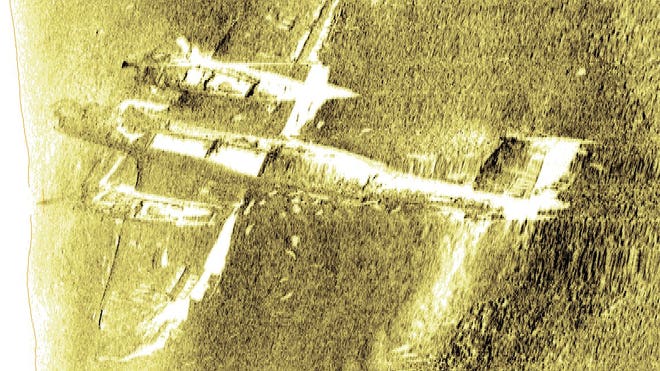
Side-scan sonar imaging provides a haunting look at the Nazi bomber, which the RAF museum plans to salvage in late May.Port of London Authority/RAF museum
-
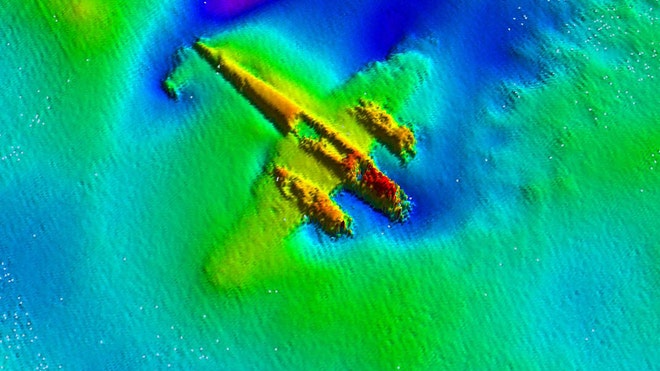
A sonar image reveals the body of the Dornier, half buried beneath the sands of the English Channel.Port of London Authority/RAF museum
-
A British Museum will finally haul the only remaining Nazi Dornier bomber from the World War II Blitz on London from its watery resting place in the English Channel at midnight on Monday-- if the witching hour stills the waters and calms the winds, that is.
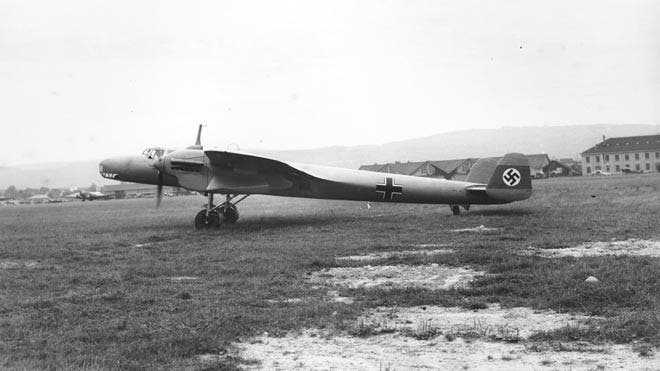
The plane, one of a formation of German Dornier Do-17 that Hitler sent to the southeast coast of England in his efforts to blast the country out of World War II, has sat in a shallow grave 60 feet underwater since it was shot down in 1940.
It had been lost for decades, buried beneath the time, the tides and the seafloor of Goodwin Sands, a large sandbank off the coast of Kent County, the last bit of rolling English countryside before Britain gives way to the straits of Dover, 20 or so miles of cold sea, and ultimately, France.
The Royal Air Force Museum now plans to recover the plane at midnight; it had previously announced multiple attempts for the lift that were stymied by the weather. Early Monday, the museum had identified two possible times -- between 3:30 p.m. and 6 p.m. on Mon., June 10, or between 3:30 a.m. and 6:30 a.m. on Tues., June 11 -- updates that were themselves updated.
The caution is necessary: After all, it's an historic restoration effort years in the making, said project manager Ian Thirsk, head of collections at the RAF Museum, in an earlier interview with FoxNews.com.
"It's been three years to plan this project, so the last stages are obviously critical," Thirsk explained.
FoxNews.com had previously reported that the museum planned to recover the Dornier-Do 17 during the week of June 2, but inclement weather had prevented the effort from going forward. The first attempt to recover the plane was nearly successful, but the museum called it off, due to high winds.
Sidescan sonar images revealed the silhouette of the craft in 2008, as the shifting sands exposed the perfectly preserved plane for the first time. The Dornier's very existence is remarkable: It's a-one-of-a-kind piece of history, he said.
"There are no other Dornier 17s left that we're aware of," Thirsk told FoxNews.com. "I really can't stress enough how important this is."
The Dornier's rarity is an odd fact of the era: The hundreds of fighters that England shot down were smelted during the war and reused, ironically turned into British aircraft to continue the battle against the Germans.
"We've got a Spitfire and a Hurricane and a German Messerschmidt," Peter Dye, director general RAF Museum, told FoxNews.com last month. "All the other aircraft were sent to smelters and recycled, ironically enough into our aircraft."
"You might say it's environmentally sound," he added wryly.
Once pulled from the waters, exposure to air will immediately begin to degrade the plane, Thirsk explained. So the RAF Museum, in conjunction with the Port of London Authority, the National Heritage Memorial Fund, and Imperial College London have designed an elaborate process of preservation.
After a special lift raises the plane from the seafloor, it will be doused with sea water and covered with chemicals and gels to preserve it, before the wing section is removed for transportation.
It will then be driven a few hours down the highway -- likely the first time a Nazi craft has navigated England's roads in half a century.
The preservation process involves a months-long -- or even years-long -- lemon-juice shower, an odd solution devised by the Imperial College's Department of Material Science that strips away the Channel's chemicals and prevents exposure to oxygen.
By washing away the chloride with citric acid, the surface is effectively protected and a barrier to further corrosion built, Dye explained. The process is lengthy, and the entire proceeding will cost roughly half a million pounds (around $750,000). But the uniqueness of the find makes it truly worthwhile, he told FoxNews.com.
"We feel that this is a unique survivor, the only German bomber from the Blitz that's left. And it's hugely important to British national history," he said.



0 comments:
Post a Comment